Projects
- Current Projects
- Completed Projects
- Improving Communities
- Seismic Safety
UC San Diego's continuing physical transformation aims to improve accessibility and amenities to encourage and welcome learners, faculty, staff, patients, alumni and visitors to experience the breadth of our activities.
See also:
The proposed Hillcrest Campus Phase 2 Utility Undergrounding Project would underground the existing overhead electrical and telecommunications facilities throughout the Hillcrest Campus gateway, specifically along Arbor Drive between Front Street and First Avenue and First Avenue between Arbor Drive and Montecito Way. The Hillcrest Campus 2019 LRDP identified an overhaul of the campus utility and infrastructure systems, including undergrounding current utilities, to upgrade the existing utilities systems, improve infrastructure reliability and promote a more resilient campus overall.
An ambitious program to rebuild the UC San Diego Hillcrest campus will provide new facilities, new technology, increased capacity, expanded care offerings, workforce housing and other community services and amenities. Over the next 10+ years, construction on the $2.5-$3 billion project will be completed in five major phases, during which the majority of the existing buildings will be replaced. This work will help ensure the university’s mission to drive innovation and deliver world-class medical care, research and education for many decades to come.
UC San Diego Health is advancing the next major phase of campus redevelopment: the Hillcrest Medical Center Renewal Project would replace the current hospital facility, originally constructed in 1963 as the county hospital. The program will include approximately 300 licensed beds and a Level One Trauma Center. The hospital will total approximately 800,000 GSF, including a central utility plant of approximately 40,000 GSF. The total site improvement area is 345,000 square feet. The Advanced Work Phase, which includes procurement, demolition, site preparation, and vegetation clearing activities, is expected to begin late summer 2026, with major construction activities anticipated to begin summer 2027.
The new La Jolla Outpatient Pavilion will be a four-story OSHPD3 facility located on the La Jolla Medical Campus. The overall project site area is 2.75 acres and the building is anticipated to be approximately 180,000 gross square feet. This proposed facility will provide hospital-licensed services and programs to support the UC San Diego Health system, serving as a platform to improve outpatient care delivery. This facility will contain disease-specific centers, ancillary, professional and support services needed to treat specified conditions. The Outpatient Pavilion will be designed and constructed as a HCAi/OSHPD3 compliant outpatient and clinic facility.
This outpatient facility will be Orthopedic and Neurosurgery focused and will include a surgery platform, an imaging platform, Interventional Radiology, Ortho/Neuro Clinical Exam w/in-clinic diagnostic testing, rehabilitation services, Theranostics and Urgent Care
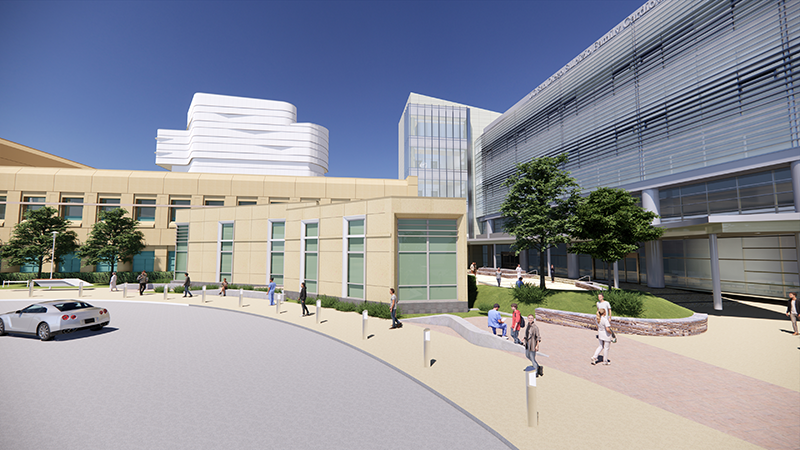
Project rendering
Thornton Pavilion, completed in 1993, is a four-story inpatient hospital located in La Jolla. The project will include an addition of approximately 3,100 square feet to the existing radiology suite in Thornton Pavilion, as well as an interior remodel of approximately 700 square feet, to accommodate two new magnetic resonance imaging (MRI) treatment rooms and related support space. The project is driven by increased patient volume and technology advances requiring an expansion of the existing MRI space.
In addition to the two new MRI units with required support spaces, the project scope also includes the addition of one MRI equipment room; a shared control room; an outpatient holding with two dressing rooms, an inpatient holding for approximately three patients, a teamwork station, a patient toilet; and a soiled hold room. The scope includes electrical, mechanical, and geotechnical upgrades required to support the expansion space. The project is designed to maintain existing MRI operations during construction.
Pepper Canyon East District proposes to develop on a 20-acre site on the west campus adjacent to the Light Rail Transit station. The District would be built in multiple phases and would include new student beds to expand access to the benefits of below market on-campus housing. Pepper Canyon East District will remove the existing housing and build approximately 6,000 beds, a hotel, food and beverage, recreation, and amenity spaces.
The project includes the expansion and renovation of RIMAC. The expansion of Levels 3 and 4 will add new program space, including reception, fitness areas, top rope climbing and bouldering, a multipurpose studio, training lab, rejuvenation spaces and associated support spaces, such as a break room, storage, IT and electrical rooms.
The project also improves building entry and internal circulation while enhancing the overall recreation experience. Exterior improvements include the development of outdoor fitness areas and site work that transforms underutilized spaces into purposeful fitness and social areas, including a new micromobility area. The expansion is intended to increase recreation capacity and support the campus’s growing student enrollment.
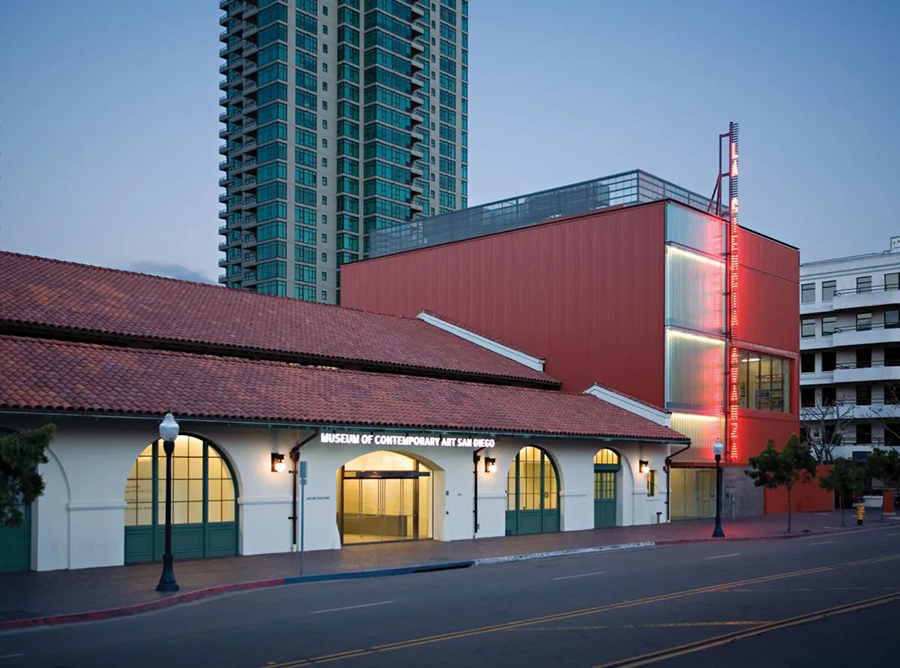
Project rendering
UC San Diego recently purchased 1100 Kettner Blvd,, the former Museum of Contemporary Art building in downtown San Diego. The property consists of the historical Jacobs building (~1915) and the modern Copley building (2006). The historical Jacobs building was originally constructed as part of the original Sante Fe Train Depot.
The project aims to create a welcoming community destination promoting neighborhood cultural exchange, including a new café and bar that encourages gathering with activation in the lobby space. The project will include a comprehensive code-required seismic retrofit and interior renovations in the Jacobs portion of the building, including repairs needed to address accessibility and code-required upgrades. Additional interior renovations will create a multidisciplinary arts space that offers flexibility to serve a variety of arts and performances. The resultant project aims to enhance partnerships within the San Diego community by creating a gateway between UC San Dieog and other organizations, providing the resources and facilities for non-profits to grow audiences and build a sustainable business model.
Complete our Customer Feedback Form.